

The Accounts Payable Automation – Where is the value?

Controllers rank accounts payable as the most time-consuming, laborious, and paper-intensive finance and administration function, ahead of activities such as accounts receivable, payroll, tax, and audit and reporting, according to IOFM’s 2016 Accounts Payable Key Performance Indicators Study.

As shown in the following table, these are general phases which every invoice has to go through. Each phase is people based, paper intensive and time consuming activities.

<table style="width:100%; border-collapse:collapse;">

 <thead>

   <tr>

     <th style="text-align:left; padding:8px; border-bottom:2px solid #ccc;">Process</th>

     <th style="text-align:left; padding:8px; border-bottom:2px solid #ccc;">Description of Activities</th>

   </tr>

 </thead>

 <tbody>

   <tr>

     <td style="padding:8px; vertical-align:top;"><strong>Invoice Receipt</strong></td>

     <td style="padding:8px;">Vendors generate the customer invoice through their ERP system. The invoice is printed and sent to customers for processing and payment. In this process, vendors have no control over the invoice receipt by the customer. This process is people-based, inefficient, and prone to missing invoices and late payments.</td>

   </tr>

   <tr>

     <td style="padding:8px; vertical-align:top;"><strong>Routing to Right Person</strong></td>

     <td style="padding:8px;">The invoice has to be routed to the right person for approvals by one or more approvers prior to payment. This manual process of identifying the right person and following up for delays is difficult, especially in case of invoice disputes. There is no visibility or control in the invoice processing workflow.</td>

   </tr>

   <tr>

     <td style="padding:8px; vertical-align:top;"><strong>Invoice 3-Way Matching</strong></td>

     <td style="padding:8px;">PO-based invoices need to be matched with the Purchase Order and Goods Receipts before acceptance. This manual process is cumbersome and time-consuming, involving multiple teams to resolve issues like quantity mismatch, price mismatch, or items not received.</td>

   </tr>

   <tr>

     <td style="padding:8px; vertical-align:top;"><strong>Exception Handling</strong></td>

     <td style="padding:8px;">Invoices require processing for exceptions such as wrong PO, incorrect tax application, vendor data mismatch, 3-way matching failures, or incorrect cost centres. Multiple stakeholders are involved in resolving these issues, and manual routing and tracking make the process difficult and people-dependent.</td>

   </tr>

   <tr>

     <td style="padding:8px; vertical-align:top;"><strong>Invoice Payment</strong></td>

     <td style="padding:8px;">Supplier payments are consolidated after all exceptions and approvals are completed. Payments are processed through the ERP system and made via cheque or clearinghouse.</td>

   </tr>

   <tr>

     <td style="padding:8px; vertical-align:top;"><strong>Duplicate Invoice</strong></td>

     <td style="padding:8px;">Duplicate invoice payments occur frequently and often go unnoticed. Detecting duplicates requires expensive and intensive manual processes, and many are never identified or resolved.</td>

   </tr>

 </tbody>

</table>

Once we understand the processes involved, it should be easy to see why the financial controllers rank the accounts payable as most time consuming and paper intensive. If we acknowledge the people dependent, paper intensive and inefficiencies of manual process-, why so many companies are still using manually processing vendor invoices?

What values customers are looking from Accounts Payable Automation?
  • Improved Visibility into Invoices received, Invoice ready for payment, Invoices in exceptions for better cash flow and cash management
  • Reduce cost of Invoice processing
  • Improve AP team productivity
  • Improve volume of Invoices processed Straight-through
Intertec’s Accounts Payable Automation Solution – delivering the value

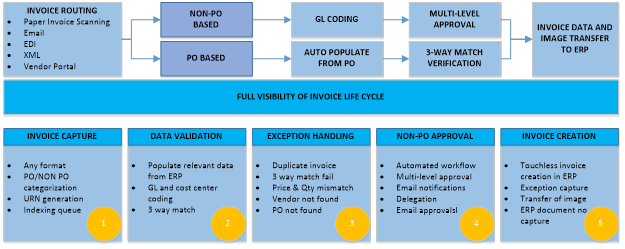
Integrates directly with your ERP application to streamline the arrival to and handling of your invoice documents while providing a full visibility from invoice receipt to payment status

  1. 100 % VISIBILITY AND CONTROL OF INVOICE LIFE CYCLE: Oversee the entire invoice life cycle and payment status with 100% visibility and control. Since the entire AP process is electronic and 100% visible from start to finish, it is much easier to plan and forecast as well as identify areas of improvement in the process
  2. 25 TO 60% HEADCOUNT REDUCTION
  3. AUTOMATIC ROUTING OF INVOICE ON EXCEPTIONS : Configurable exception queues, specifically designed to route invoice exceptions to concerned team/person based strictly on your business rules
  4. AUTOMATED 3-WAY MATCH: Automatic 3-Way match verification based on PO data, delivery challan and receipt data.
  5. AUTOMATED ROUTING OF NON-PO INVOICES: workflow based automatic routing for approval based on GL/cost center or user defined business rules
  6. SELF- SERVICE FOR VENDOR on Invoice submission, payment status and for query handling
accounts-payable-automation

Thank you! Your submission has been received!
Oops! Something went wrong while submitting the form.
𝕏
Related Topics

Cloud

Technology

AI & ML

Data Science

Hacking

The Accounts Payable Automation – Where is the value?

Published:
July 16, 2025

Controllers rank accounts payable as the most time-consuming, laborious, and paper-intensive finance and administration function, ahead of activities such as accounts receivable, payroll, tax, and audit and reporting, according to IOFM’s 2016 Accounts Payable Key Performance Indicators Study.

As shown in the following table, these are general phases which every invoice has to go through. Each phase is people based, paper intensive and time consuming activities.

<table style="width:100%; border-collapse:collapse;">

 <thead>

   <tr>

     <th style="text-align:left; padding:8px; border-bottom:2px solid #ccc;">Process</th>

     <th style="text-align:left; padding:8px; border-bottom:2px solid #ccc;">Description of Activities</th>

   </tr>

 </thead>

 <tbody>

   <tr>

     <td style="padding:8px; vertical-align:top;"><strong>Invoice Receipt</strong></td>

     <td style="padding:8px;">Vendors generate the customer invoice through their ERP system. The invoice is printed and sent to customers for processing and payment. In this process, vendors have no control over the invoice receipt by the customer. This process is people-based, inefficient, and prone to missing invoices and late payments.</td>

   </tr>

   <tr>

     <td style="padding:8px; vertical-align:top;"><strong>Routing to Right Person</strong></td>

     <td style="padding:8px;">The invoice has to be routed to the right person for approvals by one or more approvers prior to payment. This manual process of identifying the right person and following up for delays is difficult, especially in case of invoice disputes. There is no visibility or control in the invoice processing workflow.</td>

   </tr>

   <tr>

     <td style="padding:8px; vertical-align:top;"><strong>Invoice 3-Way Matching</strong></td>

     <td style="padding:8px;">PO-based invoices need to be matched with the Purchase Order and Goods Receipts before acceptance. This manual process is cumbersome and time-consuming, involving multiple teams to resolve issues like quantity mismatch, price mismatch, or items not received.</td>

   </tr>

   <tr>

     <td style="padding:8px; vertical-align:top;"><strong>Exception Handling</strong></td>

     <td style="padding:8px;">Invoices require processing for exceptions such as wrong PO, incorrect tax application, vendor data mismatch, 3-way matching failures, or incorrect cost centres. Multiple stakeholders are involved in resolving these issues, and manual routing and tracking make the process difficult and people-dependent.</td>

   </tr>

   <tr>

     <td style="padding:8px; vertical-align:top;"><strong>Invoice Payment</strong></td>

     <td style="padding:8px;">Supplier payments are consolidated after all exceptions and approvals are completed. Payments are processed through the ERP system and made via cheque or clearinghouse.</td>

   </tr>

   <tr>

     <td style="padding:8px; vertical-align:top;"><strong>Duplicate Invoice</strong></td>

     <td style="padding:8px;">Duplicate invoice payments occur frequently and often go unnoticed. Detecting duplicates requires expensive and intensive manual processes, and many are never identified or resolved.</td>

   </tr>

 </tbody>

</table>

Once we understand the processes involved, it should be easy to see why the financial controllers rank the accounts payable as most time consuming and paper intensive. If we acknowledge the people dependent, paper intensive and inefficiencies of manual process-, why so many companies are still using manually processing vendor invoices?

What values customers are looking from Accounts Payable Automation?
  • Improved Visibility into Invoices received, Invoice ready for payment, Invoices in exceptions for better cash flow and cash management
  • Reduce cost of Invoice processing
  • Improve AP team productivity
  • Improve volume of Invoices processed Straight-through
Intertec’s Accounts Payable Automation Solution – delivering the value

Integrates directly with your ERP application to streamline the arrival to and handling of your invoice documents while providing a full visibility from invoice receipt to payment status

  1. 100 % VISIBILITY AND CONTROL OF INVOICE LIFE CYCLE: Oversee the entire invoice life cycle and payment status with 100% visibility and control. Since the entire AP process is electronic and 100% visible from start to finish, it is much easier to plan and forecast as well as identify areas of improvement in the process
  2. 25 TO 60% HEADCOUNT REDUCTION
  3. AUTOMATIC ROUTING OF INVOICE ON EXCEPTIONS : Configurable exception queues, specifically designed to route invoice exceptions to concerned team/person based strictly on your business rules
  4. AUTOMATED 3-WAY MATCH: Automatic 3-Way match verification based on PO data, delivery challan and receipt data.
  5. AUTOMATED ROUTING OF NON-PO INVOICES: workflow based automatic routing for approval based on GL/cost center or user defined business rules
  6. SELF- SERVICE FOR VENDOR on Invoice submission, payment status and for query handling
accounts-payable-automation

Ready to Take Control of Your Finances?

Thank you! Your submission has been received!
Oops! Something went wrong while submitting the form.
30 days free trail
No credit card required

Controllers rank accounts payable as the most time-consuming, laborious, and paper-intensive finance and administration function, ahead of activities such as accounts receivable, payroll, tax, and audit and reporting, according to IOFM’s 2016 Accounts Payable Key Performance Indicators Study.

As shown in the following table, these are general phases which every invoice has to go through. Each phase is people based, paper intensive and time consuming activities.

<table style="width:100%; border-collapse:collapse;">

 <thead>

   <tr>

     <th style="text-align:left; padding:8px; border-bottom:2px solid #ccc;">Process</th>

     <th style="text-align:left; padding:8px; border-bottom:2px solid #ccc;">Description of Activities</th>

   </tr>

 </thead>

 <tbody>

   <tr>

     <td style="padding:8px; vertical-align:top;"><strong>Invoice Receipt</strong></td>

     <td style="padding:8px;">Vendors generate the customer invoice through their ERP system. The invoice is printed and sent to customers for processing and payment. In this process, vendors have no control over the invoice receipt by the customer. This process is people-based, inefficient, and prone to missing invoices and late payments.</td>

   </tr>

   <tr>

     <td style="padding:8px; vertical-align:top;"><strong>Routing to Right Person</strong></td>

     <td style="padding:8px;">The invoice has to be routed to the right person for approvals by one or more approvers prior to payment. This manual process of identifying the right person and following up for delays is difficult, especially in case of invoice disputes. There is no visibility or control in the invoice processing workflow.</td>

   </tr>

   <tr>

     <td style="padding:8px; vertical-align:top;"><strong>Invoice 3-Way Matching</strong></td>

     <td style="padding:8px;">PO-based invoices need to be matched with the Purchase Order and Goods Receipts before acceptance. This manual process is cumbersome and time-consuming, involving multiple teams to resolve issues like quantity mismatch, price mismatch, or items not received.</td>

   </tr>

   <tr>

     <td style="padding:8px; vertical-align:top;"><strong>Exception Handling</strong></td>

     <td style="padding:8px;">Invoices require processing for exceptions such as wrong PO, incorrect tax application, vendor data mismatch, 3-way matching failures, or incorrect cost centres. Multiple stakeholders are involved in resolving these issues, and manual routing and tracking make the process difficult and people-dependent.</td>

   </tr>

   <tr>

     <td style="padding:8px; vertical-align:top;"><strong>Invoice Payment</strong></td>

     <td style="padding:8px;">Supplier payments are consolidated after all exceptions and approvals are completed. Payments are processed through the ERP system and made via cheque or clearinghouse.</td>

   </tr>

   <tr>

     <td style="padding:8px; vertical-align:top;"><strong>Duplicate Invoice</strong></td>

     <td style="padding:8px;">Duplicate invoice payments occur frequently and often go unnoticed. Detecting duplicates requires expensive and intensive manual processes, and many are never identified or resolved.</td>

   </tr>

 </tbody>

</table>

Once we understand the processes involved, it should be easy to see why the financial controllers rank the accounts payable as most time consuming and paper intensive. If we acknowledge the people dependent, paper intensive and inefficiencies of manual process-, why so many companies are still using manually processing vendor invoices?

What values customers are looking from Accounts Payable Automation?
  • Improved Visibility into Invoices received, Invoice ready for payment, Invoices in exceptions for better cash flow and cash management
  • Reduce cost of Invoice processing
  • Improve AP team productivity
  • Improve volume of Invoices processed Straight-through
Intertec’s Accounts Payable Automation Solution – delivering the value

Integrates directly with your ERP application to streamline the arrival to and handling of your invoice documents while providing a full visibility from invoice receipt to payment status

  1. 100 % VISIBILITY AND CONTROL OF INVOICE LIFE CYCLE: Oversee the entire invoice life cycle and payment status with 100% visibility and control. Since the entire AP process is electronic and 100% visible from start to finish, it is much easier to plan and forecast as well as identify areas of improvement in the process
  2. 25 TO 60% HEADCOUNT REDUCTION
  3. AUTOMATIC ROUTING OF INVOICE ON EXCEPTIONS : Configurable exception queues, specifically designed to route invoice exceptions to concerned team/person based strictly on your business rules
  4. AUTOMATED 3-WAY MATCH: Automatic 3-Way match verification based on PO data, delivery challan and receipt data.
  5. AUTOMATED ROUTING OF NON-PO INVOICES: workflow based automatic routing for approval based on GL/cost center or user defined business rules
  6. SELF- SERVICE FOR VENDOR on Invoice submission, payment status and for query handling
accounts-payable-automation