

When enterprise infrastructure spans public cloud platforms, private clouds and on-premises data centres, understanding the financial performance of technology becomes increasingly difficult. Cloud expenditure may be visible through detailed consumption reports, while data centre costs remain distributed across infrastructure investments, software licences, facilities budgets and operational support agreements.
Each environment may have established financial controls, yet enterprise leaders can still struggle to determine the complete cost of delivering an individual business service. This creates a governance challenge that conventional cloud cost management alone cannot resolve. Infrastructure teams may optimise their respective environments independently, while finance teams evaluate expenditure through accounting structures that do not fully reflect application dependencies or resource consumption.
Hybrid cloud FinOps addresses this disconnect by establishing a shared approach to technology expenditure, resource ownership and business value across infrastructure environments. Its purpose is not to make every technology platform follow an identical pricing model. It ensures financial decisions are made using consistent definitions, transparent assumptions, and clearly established responsibilities.
Why hybrid cloud changes the FinOps equation
Public cloud infrastructure generally provides consumption and billing information that can be associated with individual services, accounts and resources. Although interpreting this information can be complex, organisations have access to a relatively detailed record of technology expenditure. On-premises infrastructure presents a different financial structure. Servers, storage platforms and networking equipment may be acquired through capital investment and used over several years. Facilities, maintenance agreements, software licences, and operational staffing add costs that are not always directly attributable to individual workloads.
Private cloud environments can combine characteristics of both models. Resources may be provisioned through consumption-oriented platforms, while the underlying infrastructure remains subject to fixed capacity and long-term financial commitments. These differences become particularly important when applications depend on services across multiple environments.
An enterprise application may run its database in a private data centre, use public cloud infrastructure for customer-facing services, and rely on shared networking and security platforms. Reviewing each environment separately provides only a partial understanding of its financial performance.
The FinOps Foundation recognised this broader technology landscape in its framework revision published on 20 March 2025. The revision introduced FinOps Scopes as a core mechanism for applying financial management practices across different categories of technology expenditure.
Source: finops.org
For hybrid enterprises, this provides a useful principle: financial governance should follow the business service and the decisions that need to be made, rather than being restricted to the boundaries of individual infrastructure platforms.
Establish a common cost model without ignoring financial differences.
A hybrid cloud FinOps practice should begin by defining which costs are included in its financial assessments. Public cloud invoices, hardware depreciation, software subscriptions, facilities expenditure and managed services charges cannot simply be combined without understanding their accounting treatment and operational purpose. An enterprise may need to evaluate both the cash expenditure associated with an infrastructure investment and the portion of that investment recognised as an expense during a particular reporting period. These are different financial perspectives, and each supports different decisions.
A workload placement assessment may require a multi-year economic comparison, while a monthly operational report may focus on allocated infrastructure expenses and current consumption. The FinOps Foundation's data centre guidance identifies capital investment, depreciation, facilities expenditure, maintenance and capacity constraints as important considerations when extending FinOps beyond public cloud. A practical hybrid cost model should therefore establish common reporting categories while preserving the underlying characteristics of each environment.
| Cost dimension | Public cloud | On-premises and private infrastructure |
|---|---|---|
| Compute | Consumption charges and commitments | Hardware, depreciation and capacity allocation |
| Storage | Capacity, operations and retrieval charges | Storage platforms, maintenance and allocated capacity |
| Networking | Connectivity and data transfer | Network infrastructure, circuits and shared services |
| Software | Subscriptions and consumption-based licensing | Enterprise licences, subscriptions and maintenance |
| Operations | Support and managed services | Internal operations, facilities and managed services |
| Resilience | Replication and recovery services | Secondary infrastructure, recovery facilities and support |
The objective is not to impose artificial equivalence between these cost categories. Instead, the organisation should establish which financial measures are appropriate for operational reporting, budgeting and longer-term investment decisions. Finance stakeholders should help define these measures to prevent inconsistent treatment of capital expenditure, depreciation, and recurring operating costs.
Build a financial data architecture across environments.
Hybrid cloud FinOps depends on access to information that may originate from several independent systems. Cloud billing exports provide expenditure and consumption data. Asset management platforms contain infrastructure inventories and ownership records. Financial systems hold purchase orders, invoices and accounting information. Monitoring platforms provide utilisation and capacity measurements. Individually, these systems serve different purposes. Together, they can establish a more complete understanding of the technology resources supporting enterprise applications.
The FinOps Open Cost and Usage Specification, commonly known as FOCUS, provides a standardised approach to representing technology billing information. The FinOps Foundation has also published guidance on adapting data centre cost and usage information to FOCUS-aligned structures.
Source: FOCUS
However, adopting a common specification does not automatically resolve differences in source data, ownership records or accounting practices. Enterprises still need to establish how infrastructure assets are linked to business services, how shared expenditure is distributed, and how financial information is reconciled against approved records.
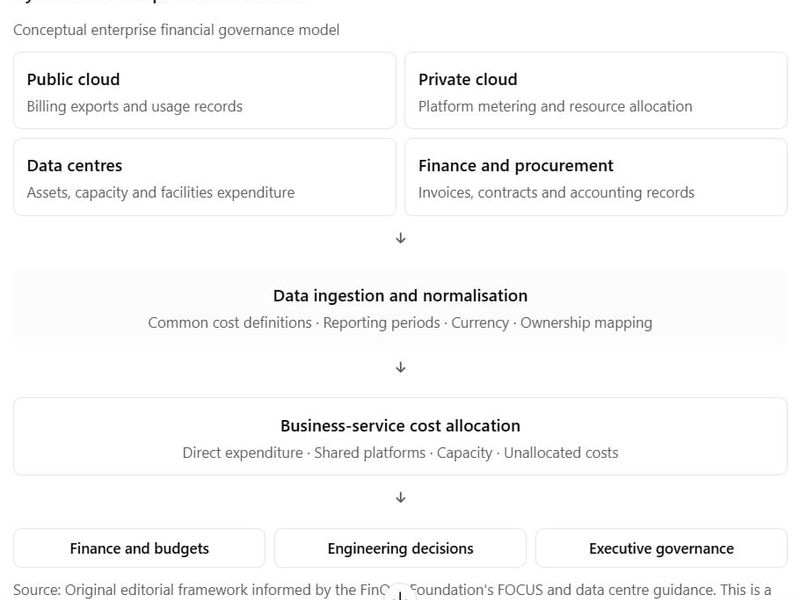
A reliable data architecture should also accommodate differences in reporting frequency. Infrastructure utilisation information may be available continuously, while accounting information is reconciled monthly. Financial reports should distinguish preliminary estimates from reconciled expenditure rather than presenting both as equally authoritative.
This distinction helps maintain confidence in the information used for operational decisions and executive reporting.
Move from infrastructure ownership to business-service accountability.
One of the more difficult aspects of hybrid cloud governance is establishing who is accountable for technology expenditure when infrastructure is shared. A cloud engineering team may manage public cloud accounts, while a separate infrastructure team operates the private data centre. Application owners may consume resources from both environments without having visibility into their combined financial impact.
This arrangement can create a separation between the teams making technology decisions and those responsible for financial outcomes. The enterprise should establish a business-service ownership model that connects applications, infrastructure resources and financial responsibilities. Each significant application or service should have an identifiable owner who understands its operational requirements, participates in financial planning and can explain changes in expenditure.
Infrastructure teams remain responsible for managing the platforms they operate. However, financial accountability should extend to the business and application decisions that determine how those platforms are consumed. The FinOps Foundation's allocation guidance supports using organisational structures, resource metadata and additional operational information to associate expenditure with responsible groups.
For hybrid environments, this can require linking cloud resource metadata with application inventories, infrastructure asset records and financial cost centres. A central ownership registry can help maintain these relationships when applications move between environments or organisational responsibilities change. Without this continuity, migration and modernisation programmes can disrupt cost reporting precisely when enterprise leaders need to understand their financial implications.
Establish transparent rules for shared infrastructure costs.
Not all technology expenditure can be directly associated with an individual application. Enterprise networking, security platforms, virtualisation environments, storage infrastructure and disaster recovery facilities may support several business services simultaneously. Allocating these costs requires a policy that reflects how the organisation consumes shared capabilities and what behaviours it intends to encourage. An enterprise might allocate certain costs based on reserved infrastructure capacity, actual resource consumption, or the number of supported users. Other costs may remain centrally funded because distributing them would introduce unnecessary administrative complexity.
The important consideration is whether the allocation method is transparent and appropriate to the underlying service. For example, allocating the cost of a shared storage platform solely by application count could disadvantage smaller applications while understating the needs of data-intensive workloads. Allocating according to storage consumption may provide a more meaningful distribution, although additional considerations such as performance requirements and replication policies could still influence the cost.
Similarly, a shared security platform may be better treated as an enterprise-wide investment when its primary purpose is maintaining a common level of organisational protection. The allocation policy should distinguish between costs that business units can influence and costs that remain outside their immediate control. This distinction prevents financial accountability from becoming a mechanism for assigning responsibility without providing the corresponding authority to make improvements.
Introduce showback before implementing chargeback.
Financial transparency and internal financial recovery are related but distinct objectives. Showback provides business units and application owners with visibility into the technology expenditure associated with their activities. Chargeback goes further by transferring or recovering those costs through internal financial arrangements. An organisation does not necessarily need to introduce both mechanisms simultaneously.
For enterprises establishing hybrid cloud FinOps, showback can help validate cost models, improve ownership records, and resolve disagreements about shared expenditure before those calculations affect departmental budgets. An application owner should be able to understand why a particular infrastructure cost has been assigned to their service and how that allocation changes when resource requirements increase or decrease. If the underlying information is incomplete, introducing chargeback prematurely may create disputes rather than encourage responsible consumption.
Once allocation rules are sufficiently reliable and accepted, finance teams can determine which services should be subject to formal internal recovery arrangements. The objective should remain better financial decision-making, not distributing every infrastructure expense for its own sake. A transparent central funding arrangement can be appropriate for some enterprise services, particularly where their benefits are collective, or their consumption cannot be measured economically.
Connect forecasting with capacity planning.
Hybrid cloud environments require financial forecasts that reflect both consumption-driven expenditure and longer-term infrastructure commitments. A public cloud workload may increase its resource consumption relatively quickly. Expanding physical data centre capacity, however, can involve procurement, installation, licensing and facilities considerations.
The financial implications of these decisions occur over different timescales. A forecasting model based solely on historical monthly expenditure may therefore provide insufficient visibility into future infrastructure requirements. Engineering teams should provide information on expected application demand, planned migrations, platform upgrades, infrastructure refresh cycles, and anticipated changes in service requirements.
Finance and procurement teams should incorporate the associated investment commitments, contractual obligations and budget constraints. The FinOps Foundation's forecasting and budgeting capabilities provide a basis for connecting expected technology requirements with financial planning and approved funding.
In a hybrid environment, these practices should be supported by scenario-based planning. For instance, an enterprise preparing to expand a digital service may need to evaluate whether its existing private infrastructure can support additional demand, whether public cloud resources are required during peak periods and whether new capacity investment will be necessary.
Each scenario should identify the expected financial consequences, implementation lead times and operational constraints. This enables technology and finance leaders to evaluate expenditure before infrastructure decisions become difficult or expensive to reverse.
Avoid misleading comparisons when deciding workload placement.
A common objective of hybrid cloud FinOps is determining where workloads should operate. However, comparing public cloud charges with the allocated cost of an existing data centre environment can produce misleading conclusions if the assessment uses inconsistent financial assumptions. Consider an enterprise with unused capacity in its private infrastructure. Moving an additional workload into that environment may require relatively little incremental expenditure in the short term.
That does not necessarily establish that expanding the same infrastructure would be the most economical long-term decision. Similarly, migrating a workload to public cloud may reduce the resources required within the data centre without immediately reducing existing depreciation, lease commitments or support contracts.
The enterprise should distinguish between three financial perspectives:
- Allocated cost: The portion of existing infrastructure expenditure assigned to a workload.
- Incremental cost: The additional expenditure associated with a particular decision.
- Avoidable cost: The expenditure that can actually be eliminated if a workload is moved, redesigned or retired.
These measures support different decisions and should not be treated as interchangeable. A workload placement assessment should also account for migration expenditure, application performance, resilience, connectivity, information governance and operational support requirements. FinOps provides the financial context for these decisions. It does not replace architectural assessment or business risk management.
Define a governance model that supports action.
A hybrid cloud FinOps practice becomes effective when financial information leads to decisions and those decisions have accountable owners. A monthly report showing infrastructure expenditure is useful, but it does not establish who should investigate unexpected changes, approve additional capacity or implement improvements. The enterprise should establish a governance model that connects operational responsibilities with financial authority.
| Stakeholder | Primary accountability |
|---|---|
| CIO and technology leadership | Technology investment priorities and operating model |
| Finance | Accounting policy, budgets and financial reconciliation |
| FinOps team | Cost visibility, allocation methodology and decision support |
| Infrastructure and cloud teams | Platform capacity, resource efficiency and technical controls |
| Application owners | Service demand, workload forecasts and expenditure decisions |
| Procurement | Contractual commitments, licensing and supplier economics |
| Security and compliance | Governance constraints and acceptable operational risk |
The FinOps function should enable collaboration between these stakeholders rather than becoming the sole owner of every technology cost. Application teams should retain responsibility for the resource decisions they can influence. Finance should maintain authority over approved financial treatment and budget processes. Technology leadership should resolve trade-offs involving competing business priorities.
A regular governance cadence can support this arrangement. Operational reviews can address unexpected consumption changes and emerging capacity issues, while monthly financial reviews can examine expenditure against forecasts and approved budgets. Longer-term investment reviews should assess infrastructure commitments, refresh requirements and workload placement decisions.
Adapt financial governance to GCC enterprise requirements.
For enterprises operating across the GCC, hybrid infrastructure strategies may be shaped by existing data centre investments, regional cloud availability, business continuity requirements and applicable information governance obligations. A multinational organisation may also operate across legal entities with different procurement arrangements, currencies and financial reporting structures.
These considerations can influence how technology expenditure is allocated and how infrastructure decisions are evaluated. For example, a workload may need to remain within an approved environment even when an alternative deployment appears less expensive. The financial assessment should make the cost of that requirement visible without treating the requirement itself as an inefficiency.
Similarly, shared infrastructure supporting multiple jurisdictions may require allocation policies that align with the organisation's legal entity structure and internal financial arrangements. Regional relevance should therefore be incorporated into the governance model rather than expressed through unsupported claims that one infrastructure environment is universally more appropriate for GCC enterprises. Validate specific data residency, tax, accounting, and sector-related obligations with the organisation's relevant specialists.
Measure whether financial accountability is improving.
Evaluate the effectiveness of hybrid cloud FinOps through measures that reflect both the quality of financial information and the organisation's ability to act on it. An enterprise should be able to establish whether technology expenditure is becoming more attributable, whether forecasts are becoming more useful and whether approved improvements are producing measurable financial outcomes.
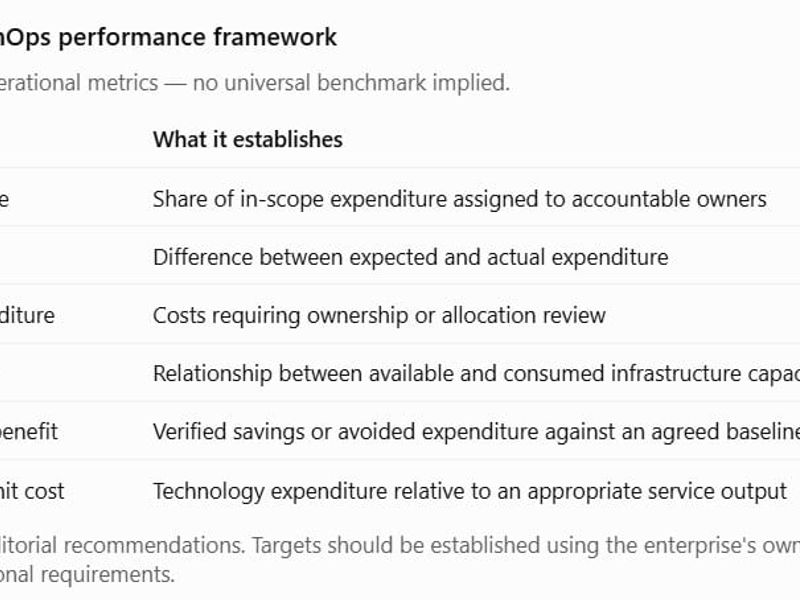
These measures require consistent definitions and reporting boundaries. An apparent improvement in allocation coverage, for example, may have limited value if costs are assigned using unreliable ownership information. Likewise, a reduction in cloud expenditure should not automatically be recorded as a financial benefit if equivalent costs have been transferred to another infrastructure environment. The governance process should validate the business consequences of each improvement and distinguish realised financial benefits from estimated opportunities.
Building a financially accountable hybrid cloud operating model
Hybrid cloud infrastructure provides enterprises with different options for delivering applications and managing technology capacity. However, its financial complexity requires an operating model that connects infrastructure decisions with business responsibilities. Establishing common cost definitions, integrating financial and operational information, documenting allocation policies and aligning forecasting with capacity planning creates a stronger basis for those decisions.
The objective is not to eliminate the differences between public cloud and private infrastructure. It is to ensure that those differences are understood and incorporated into financial governance. When application owners, engineering teams, finance and procurement operate from a shared understanding of technology expenditure, enterprises are better positioned to evaluate infrastructure investments and manage the financial consequences of changing business requirements.
Hybrid cloud FinOps becomes valuable when cost visibility drives accountable decisions across the entire technology environment.
Intertec Systems can help enterprises assess their hybrid infrastructure operating model and identify opportunities to strengthen financial visibility, resource governance, and technology accountability.